
December 6, 2025
Sermon Part 3C: The Story of David and Bathsheba: “Oh, the Trove of Treasure That Dwells Within the Truth!”
Happy Sunday Saints of the Most-High God!

Introduction
The Poet John Milton wrote, “Behind every dark cloud is a silver lining.” The idiom means that even in the worst situations we face in life, there is some hidden benefit or hopeful-side, and it serves as encouragement to maintain optimism during hardship. Let’s be candid here Saints. Many of the “dark clouds” and “dark days” we have experienced in life showed up because of our own “deliberate” and “foolish” choices and decisions made knowing full-well they were contrary to God’s Word; they were in opposition to the Truth.
Rather than insulating our hearts with the Word of God and obeying the Voice of the Lord, we chose and decided instead to “despise” the Truth, and exalt our knowledge above the Truth. We made a conscious decision to disrespect the Authority of the Truth, and lowly esteemed the value of God’s divine Wisdom. After sinning, we even had the audacity to mock God by blaming others for our sin-actions, or to justify our wrongdoing by saying things like, “God knows my heart,” or “God will forgive me.”
For all those in Christ, through the finished works of Jesus Christ on the cross, God has surely forgiven all of our sins, and does not judge and condemn us for it. The Apostle Paul wrote at Romans 8:1, “There is therefore now no condemnation to them which are in Christ Jesus, who walk not after the flesh, but after the Spirit.”
However, while there is no condemnation (damnation) for the sin committed for those of us in Christ, there are still earthly consequences realized for sinning. Doing evil will bring dark clouds and severe storms over your life. But, Praise God, behind and above every dark cloud (the sin) God has reserved a blessing for us when we walk in the Truth about our sin. As we will see in Today’s Message, this was certainly the case in the story of King David and Bathsheba told in II Samuel Chapters 11 and 12. For David’s sins against God brought severe consequences on himself, his household, and the nation of Israel.
If instead, David had chosen and made the decision to hide the Law of Moses in his heart, and rehearsed and kept the Commandments concerning the conduct of a king of Israel, (Deut.17:16-20) he would never have had the sorted affair with Bathsheba, had a child out of wedlock, nor killed Uriah her husband, and suffered the severe judgments he had to endure. God working with David, his kingdom would have been advanced throughout the world; prospering exponentially more than it did, and he would have been known as one of the greatest kings of the earth, just as God had Covenanted with him to do. (II Sam.7:9 & 12:8)
God’s Divine Judgment Brought Great Tragedy upon David, His House, and Israel
As discussed last week, for about one-year, David had kept to himself the “secret-sin” of his illicit affair with Bathsheba, the arrangement and execution of her husband Uriah (a faithful trusted soldier in the Army of Israel), as well as the birth of the couple’s first child (a son) conceived from the adultery. God sent the Prophet Nathan to confront David with the Truth: That he was the “man” who had done “evil” in the sight of the Lord in murdering Uriah with the sword of the children of Ammon, the enemy of Israel, and taking his wife as his own. (II Sam.12:9) In taking these actions, David had despised the Law of Moses and Covenant God had made with him. This brought severe judgment upon David and His House.
Again, let’s review the Judgments recorded at II Samuel 12:9-14.
9 Wherefore hast thou despised the commandment of the Lord, to do evil in his sight? thou hast killed Uriah the Hittite with the sword, and hast taken his wife to be thy wife, and hast slain him with the sword of the children of Ammon.
10 Now therefore the sword shall never depart from thine house; because thou hast despised me, and hast taken the wife of Uriah the Hittite to be thy wife.
11 Thus saith the Lord, Behold, I will raise up evil against thee out of thine own house, and I will take thy wives before thine eyes, and give them unto thy neighbor, and he shall lie with thy wives in the sight of this sun.
12 For thou didst it secretly: but I will do this thing before all Israel, and before the sun.
13 And David said unto Nathan, I have sinned against the Lord. And Nathan said unto David, The Lord also hath put away thy sin; thou shalt not die.
14 Howbeit, because by this deed thou hast given great occasion to the enemies of the Lord to blaspheme, the child also that is born unto thee shall surely die.
Look at the dark clouds that moved in and hovered over King David’s life and house. Nathan told David to “behold” (see and know in your heart/spirit) God’s divine judgment for his sin with Bathsheba: His family would be afflicted with violence and strife. Specifically, the sword would not depart from his house, his wives would be publicly shamed, and he would suffer the death of the innocent newborn child they conceived, though God ultimately granted David repentance and spared his life and kingdom, while Bathsheba was not directly punished.
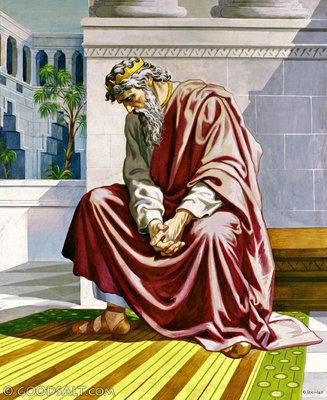
God’s divine judgment introduced “the spirit of calamity” on David’s house: If you will, the continual rolling in of storms of misfortune and disaster resulting from sin and disobedience to God’s Word. These calamities would not just fill the royal house and family of King David, but also cause him serious emotional stress and health problems throughout his life. Further, the calamities of David’s house would become public for all of Israel to see, and work to divide the kingdom of Israel with a civil war of heavy blood-shed and death. The preponderance of calamities within and outside of the Palace would force David to his knees; crying out to God for mercy and deliverance from his self-inflicted chaos.
In brief summary, the calamities in the Royal House of David included:
*The infant child born to David and Bathsheba was stricken with a “great sickness.” (II Sam 12:15-18) David, having repented of his sins against God before the Prophet Nathan for the murder of Uriah and adultery committed with Bathsheba, besought God for the child, with fasting, weeping, and prayer (hoping through the “grace” of God the child would be healed).

But, within seven days, the child died as God said it would. Ultimately, David would exclaim to the elders of his house; that though the child had not returned to him as he had prayed, one day he would go and be with him. (II Sam.12:23) Meaning, David had faith that when he died, he would be reunited with his child in the afterlife in Paradise (Abraham’s bosom, a compartment of hell, where the righteous Old Testament Saints went at death until the coming of Jesus Christ and His finished works on the cross took them captive to Heaven.)
*David’s beloved daughter Tamar, despite her pleas, suffered the horror of being raped and abused by his son Amnon (Tamar’s half-brother). (II Sam.13:1-15) When David heard the news of what Amnon had done to Tamar, “He became very angry,” but took no action against his son. (II Sam.13:21) David’s inaction in the matter sorely displeased his son Absalom (the brother of Tamar) who hated Amnon for his evil deed, and ignited within Absalom’s heart the spirit of rebellion against his father David.
Two-years later, in an act of vengeance for the rape of Tamar, David’s son Absalom murdered Amnon. (II Sam.13:23-32) David’s immediate reaction to the news of Amnon’s death was profound grief. As part of Absalom’s rebellion against his father for failing to punish Amnon for Tamar’s rape, which left her desolate and without a proper remedy, he took his concubines and had sex with them in front of the entire nation of Israel, fulfilling God’s judgment against David for his sins. (II Sam.16:21-22) The incident took place on the Palace roof-top; the same place where David lusted after Bathsheba as she bathed.
This public act was a profound humiliation for David, and meant by Absalom to demonstrate that the rift between he and his father was beyond reconciliation. This took place concurrently with Absalom leading a rebellion to attempt to seize his father’s throne. (II Sam. Chaps.13-18)
Driven by a desire for revenge and ambition, Absalom turned the hearts of many people against his father. Absalom’s followers declared him king of Hebron, and he then led an army to attack Jerusalem, his goal being to become king of all of Israel.

David, with his loyal followers, fled Jerusalem to escape Absalom’s forces. Thereafter, David gathered forces and made strategic decisions to outmaneuver Absalom. David’s army clashed with Absalom’s rebels in the Forest of Ephraim where there were heavy casualties, especially to Absalom’s forces. During the battle, Absalom’s hair became caught in a tree, and David’s commander, Joab, killed him which led to the defeat of the rebellion. In II Samuel 18:33 records David’s lamenting the news of Absalom’s death:
And the king was much moved, and went up to the chamber over the gate, and wept: and as he went, thus he said, O my son Absalom, my son, my son Absalom! Would God I had died for thee, O Absalom, my son, my son!
David’s profound paternal love for his rebellious son is revealed in his lament. Despite the victory and Absalom’s treachery, David was overcome with profound grief at the death of his son. A period of national mourning was made for Absalom. When David reestablished himself as king of all of Israel and returned to the Palace, he was faced with the fate of the ten concubines he had left behind to care for the Palace.
He placed the women in a guarded house, providing for them, but effectively he treated them as widows. (II Sam. 20:3) This decision was based on the cultural and legal implications of the concubines having been with Absalom. To take them back would have been considered detestable according to Mosaic Law. (Deut. 24:3-4)
*Lastly, through the many dark days of David’s life, he also suffered both mental and physical illnesses that he acknowledged before God were directly caused by his sinful behavior. While David repented of his sin (such as the adultery with Bathsheba and the murder of Uriah), the consequences were not erased. Among the major sicknesses David suffered was venereal disease, which he apparently contracted from his affair with Bathsheba, as well as depression and anxiety, and Post-Traumatic Stress Disorder from war. Examine the lamentations of David at Psalm 38:1-12 and 41:7-12 concerning venereal disease:
38 O Lord, rebuke me not in thy wrath: neither chasten me in thy hot displeasure.
2 For thine arrows stick fast in me, and thy hand presseth me sore.
3 There is no soundness in my flesh because of thine anger; neither is there any rest in my bones because of my sin.
4 For mine iniquities are gone over mine head: as an heavy burden they are too heavy for me.
5 My wounds stink and are corrupt because of my foolishness.
6 I am troubled; I am bowed down greatly; I go mourning all the day long.
7 For my loins are filled with a loathsome disease: and there is no soundness in my flesh.
8 I am feeble and sore broken: I have roared by reason of the disquietness of my heart.
9 Lord, all my desire is before thee; and my groaning is not hid from thee.
10 My heart panteth, my strength faileth me: as for the light of mine eyes, it also is gone from me.
11 My lovers and my friends stand aloof from my sore; and my kinsmen stand afar off.
12 They also that seek after my life lay snares for me: and they that seek my hurt speak mischievous things, and imagine deceits all the day long.
Psalm 41:7-12
7 All that hate me whisper together against me: against me do they devise my hurt.
8 An evil disease, say they, cleaveth fast unto him: and now that he lieth he shall rise up no more.
9 Yea, mine own familiar friend, in whom I trusted, which did eat of my bread, hath lifted up his heel against me.
10 But thou, O Lord, be merciful unto me, and raise me up, that I may requite them.
11 By this I know that thou favourest me, because mine enemy doth not triumph over me.
12 And as for me, thou upholdest me in mine integrity, and settest me before thy face for ever.
13 Blessed be the Lord God of Israel from everlasting, and to everlasting. Amen, and Amen.
Additionally, Medical science examinations of the Psalms of David report David may have also suffered from osteoporosis/malignancy, Parkinson’s disease and Dementia and Hypothyroidism during the later stages of his life. Yet, even through all of his suffering David steadfastly looked towards the Only True God for mercy and deliverance. Though judged as “The Man” who had sinned against God, David through-out his life proved what it really means to be a “Man after God’s own Heart,” as he worshipped only the Lord through pain, sorrow, and adversity. David expressed his pain in his psalms, lamenting his circumstances, but also he chose to focus on God’s faithfulness and goodness, turning his anguish into ardent praise and declaring God’s worthiness of worship in suffering. Saints, it’s easy to praise and worship God when the sun is shining on your life each day, but much more difficult when days, and seasons are dark and grey. At Psalm 56:3, David wrote “When I am afraid, I will trust in thee.” In Psalm 16:1, he declared “Preserve me, O God: for in thee do I put my trust.”
In Psalm 34:1-4, he declared:
“I will bless the Lord at all times: his praise shall continually be in my mouth. My soul shall make her boast in the Lord; the humble shall hear thereof and be glad.” O magnify the Lord with me, and lest us exalt his name together. I sought the Lord, and he heard me, and delivered me from all my fears.
Moreover, while worshipping God during one of the tumultuous periods of his life, David, so deep in consecration and connection with God through his suffering identified with sufferings of the coming Messiah as he pinned Psalm 22. By the Spirit of the Lord, David vividly described the suffering, abandonment, and specific details of execution, such as the piercing of hands and feet and the casting of lots for garments; for-shadowing the crucifixion of Jesus Christ. On the cross, Jesus quoted the opening Verse of Psalm 22, “My God, my God, why hast thou forsaken me?” (Matt. 27:46) In fact, many Psalms referred to the Promised Messiah which detailed events from Christ’s life, death, and Ascension; and David is credited with writing most of them.
King David died at age 70. In II Chronicles 29:28 it states that that David died in a “good old-age, full of days, riches, and honor, and Solomon his son reigned in his stead.” For in deed, “Blessed is the man whose transgression is forgiven, whose sin is covered.” (Ps. 32:1) David reigned over Israel for 40-years; seven years in Hebron and 33-years in Jerusalem. It was in the birth of Solomon that we find the manifestation of King David’s silver lining.
Within God’s Judgment of David’s Sins Was a Silver Lining
In II Samuel 12:13, the Prophet Nathan told David that his “sin had been put away and he would not die.” As mentioned last week, this was a pre-ordained grace God had placed within His judgment for David’s sins; God knowing that once confronted with the Truth David would offer true repentance for his sins against God. While there would still be severe consequences for his adultery and murder, (as aforementioned in this Sermon) God had granted David temporal forgiveness by sparing his life and throne, and spiritual forgiveness; “reconciliation” with Him.
Please Saints would you say this with me: “In the midst of the judgments and severe repercussions for sins, God reconciled David to Himself.” God separated David’s sins from the person David. My, my, my, glory be to God! When it comes to relationships with the only True God, only God can initiate the reconciliation process, which can only take place by removing the estrangement caused by sin, thereby making the way for establishing peace and harmony with God.
God does not grant such fellowship with Himself without first seeing that True repentance has been made from the heart of a man. Once the man is broken and contrite in heart about sin committed, and willing to turn from sin and obey God, God begins the process of healing and restoring the broken relationship with Him. (Ps. 51:17) David declared in Psalm 23:3 that the Lord was His Shepherd, and “He restoreth my soul.”
This silver lining judgment of removing David’s sin and allowing him to live resulted in David being restored to God to continue to carry-out the divine Purpose for which He had called, chosen, and anointed him into service and established Covenant. In the Covenant, God wanted David to remain a humble and obedient king, leading his people with God’s favor, while God would establish David’s dynasty and ensure his kingdom would last forever through a descendant (Solomon) who would build the permanent Temple. While David desired to build God a house, God Promised to build David a spiritual house of descendants, ultimately fulfilling this Promise through Jesus Christ.
The birth of Solomon was a profound benefit from the restored relationship that he enjoyed with God. David’s True repentance of his sins before God had unfolded “deep treasure” that abides within the “Truth.” Not only did God reveal to David in the spirit/heart the Wisdom of how He would deal with the sin in his heart (by blotting out his sins), but also he made David to know that after his sins were forgiven, that he would receive God’s “Loving Kindness.”
More specifically, through David’s repentance we can see that when we come before God with a broken and contrite heart about our sin, acknowledging it, confessing it, and having a willingness to turn from it and obey God; we receive God’s forgiveness, and He bestows upon us His supernatural Loving Kindness. The Kindness of the Lord is a pathway to receiving divine favor from God and others.
King David wrote at Psalm 56:1: “Have mercy upon me, O God, according to thy lovingkindness: according unto the multitude of thy tender mercies blot out my transgressions.”
David, by the Spirit of the Lord, was praying for God to show mercy on him by placing his “Loving Kindness on him” after blotting out his transgressions. He was giving God permission to continue to be the Covenant-Keeping and Faithful God in his life. At II Samuel 12:24, (after the death of David and Bathsheba’s first child) “David comforted her and laid with her and she bore a son, and he called his name Solomon (his name meant peace): and the Lord loved him.”
In the midst of immense sorrow and judgment, Solomon’s birth served as a powerful symbol of grace and redemption. A kind of rolling back and away of the dark clouds, and beams of Heaven’s Light were reigning down on the union of David and Bathsheba.

The birth of Solomon represented a culmination of “Good Omens” that had come to fruition. As David was the 8th son of Jessie, Bathsheba was David’s 8th wife in Jerusalem mentioned in Scripture, and Solomon was the 8th child mentioned in Scripter born to David (if we include the unnamed child born to Bathsheba that died). As mentioned before, the number “8” in the Bible symbolizes “New Beginnings,” “Restoration” or “Regeneration.” Additionally, Bathsheba’s name in the Hebrew meant “daughter of oath,” “covenant,” “abundance” or “prosperity.” David’s name meant “dearly beloved.” These are all Covenant-terms that bonded David and Bathsheba together with God.
The new born second child, Solomon showed that although the couple had come together in sin and treachery by the work of Satan, God had turned it around for their good. (Rom.8:28)
Solomon's life would be a testament to God's ability to bring “beauty from brokenness.” Despite the sinful origin of his parent's union, God chose Solomon to carry forward David's legacy and God's divine Plan.
Further, Solomon’s birth represented the restoration of God’s Covenant Promises after David’s great sins. God loved the child so much that he sent the prophet Nathan to give him a second name, Jedidiah, meaning "beloved of the Lord." (II Sam.12:25) This was a powerful symbol, as God revealed that David's son would be a "man of rest" who would not be a warrior like his father. Furthermore, Solomon’s birth was a major step toward fulfilling the Covenant God made with David. God had Promised to establish David's royal line forever and that one of his descendants would build the Temple. That Promise was fulfilled through Solomon, who David during his old-age oversaw the Anointing of his son by the priest Zadok and Prophet Nathan to succeed him at the Spring of Gihon. (I Kings 1:28-40)

The public Ceremony involved Solomon (around age 20) riding David’s own mule, Zadak anointing him with oil from a horn, a trumpet blast, and joyful shouts of “Long live King Solomon” from the people, affirming his legitimate succession to the throne. Thereby, quashing a vail attempt by Adonijah, another son of David’s to seize the throne, as the King had become frail and was terminally ill. Later Solomon built the first Temple in Jerusalem, according to the Covenant made with his father David. (I Kings 6:1-38)
In closing, King David’s final words spoken from his beside to Solomon, were Words of God’s Wisdom, hidden Treasure in Truth that he was to live by. This Wisdom must be heeded by all those who claim fellowship with the Only True God and Jesus Christ. A father’s last words before death are extremely important because they can provide significant counsel, summarize a life’s core values, and offer a powerful legacy to the child and generations to come.

Examine the hidden treasure of Truth David shared at I Kings 2:1-4, as he admonishes Solomon to insulate his heart and house with God’s Word, The Truth.
Now the days of David drew nigh that he should die; and he charged Solomon his son, saying,
2 I go the way of all the earth: be thou strong therefore, and shew thyself a man;
3 And keep the charge of the Lord thy God, to walk in his ways, to keep his statutes, and his commandments, and his judgments, and his testimonies, as it is written in the law of Moses, that thou mayest prosper in all that thou doest, and whithersoever thou turnest thyself:
4 That the Lord may continue his word which he spake concerning me, saying, If thy children take heed to their way, to walk before me in [truth] with all their heart and with all their soul, there shall not fail thee (said he) a man on the throne of Israel.
Saints, let’s take David’s wise counsel to heart that he shared with Solomon and insulate our hearts and homes with it. The Old Testament was given as an example for us to learn from of both the faithfulness and failures of real people. (I Cor.10:11) The saying goes, “Personal experience is a good teacher, as we can learn from our mistakes and correct them.” However, an even better way to learn is to observe someone else’s mistakes, and avoid them altogether by doing the right thing!
The only True God has given to us His Word so that we would know the right choices and decisions to make in life through obedience to His Word. (Deut. 11: 26-28) As born-again Christians, we are to be sober and vigilant as the enemy seeks to attack and devour all who have failed to insulate their thought-life with the “Truth,” God’s Word. Among his last words, David implored Solomon, to be “strong and to show himself a man.” (I Kings 2:2)
By this David was urging Solomon to be strong, responsible, and mature; not just physically, but in his character and spiritual life as the future king of Israel. To “show himself a man,” meant embracing God’s Commandments, especially those related to the conduct of a king, demonstrating integrity and leadership, and fulfilling the Covenant responsibilities of the king in wisdom, justice, and faithfulness to God. It meant accepting responsibility when he made mistakes, and embracing chastening from God when he sinned, and then humbly repenting of sin and receiving forgiveness from God, and being reconciled to God. It also meant walking humbly by putting God above all things, and people of the kingdom first in Service unto the Lord. Lastly, it meant Solomon was to have a “heart” for God: A True and deep devotion and desire to live according to God’s Will and Plans.
David’s admonition to Solomon to “show thyself a man” must echo within the chambers of our hearts too! In Christ Jesus, God has washed us from our sins in the precious blood of Jesus and made us “kings and priest” unto God the Father. (Rev.1:5) Our sins have been forgiven forever and God has reconciled us within Himself and given us the Ministry of Reconciliation. (II Cor. 5:18)
Through the finished works of Jesus Christ on the cross and Resurrection on the 8th Day, (signifying both the first day of the week, Sunday when He rose from the dead and the “beginning of a new creation.”) we are “new creatures” in Christ, and God has made a New Covenant with us, wherein He has blessed us with all spiritual blessings in heavenly places in Christ Jesus. (Eph.1:3) He has Promised to be exceedingly Kind (bestow upon us supernatural favor) towards us throughout eternity. (Eph. 2:7) He has given to us all things that pertain unto life and godliness, (II Pet.1:3) and with our New Covenant we have been told to “behold all things have become new.” (II Cor. 5:17)
These are all exceedingly greater Promises than the Promises God made under the Old Covenant. For to whom much is given is much required. (Luke 12:48) With such great mercy and grace applied to us, we must walk in the “Light” (Truth) for then we have fellowship with God, and one another. When we walk in Truth, the Only True God and Jesus Christ are free to release all of the Covenant Promises to us in physical manifestation, as we live by faith and trust in Him. The Apostle John wrote at I John 1:5-9:
5 This then is the message which we have heard of him, and declare unto you, that God is light, and in him is no darkness at all.
6 If we say that we have fellowship with him, and walk in darkness, we lie, and do not the truth:
7 But if we walk in the light, as he is in the light, we have fellowship one with another, and the blood of Jesus Christ his Son cleanseth us from all sin.
8 If we say that we have no sin, we deceive ourselves, and the truth is not in us.
9 If we confess our sins, he is faithful and just to forgive us our sins, and to cleanse us from all unrighteousness.
10 If we say that we have not sinned, we make him a liar, and his word is not in us.
We are grateful to God to have the opportunity to learn from the story of King David and Bathsheba. In a time when we have sinned and missed the mark, from David’s example, we have learned what God desires of us. That is, we are to humble ourselves in the sight of God, come before Him with a contrite and broken spirit, acknowledge and confess the sin(s), and with True repentance continue to walk in sweet fellowship with God, as the blood of Jesus Christ continually cleanses us from all sin.
Walking in the “Light” is walking in Truth, this is where we find the Only True God and Jesus Christ. For Jesus is the “Truth.” (John 14:6)

Saints, from this day forward make it your ardent zeal to walk in “Truth.” When tempted by the enemy Satan to lie, cheat, deceive, or steal; rebuke him, and speak and live by the Truth of God’s Word. (Luke 4:4) The world is filled with evil and darkness, but God has sanctified us in the Truth, to shine Light into darkness and chase away dark clouds; not just our dark clouds, but also those of others. Walk in Truth and God will make you perfect in every good work to do His Will so that you may be pleasing in his sight. Amen for the preaching of the Gospel of Jesus Christ. The last Sermon in this Series is entitled: “The Truth Is Your Shield and Buckler!”
Please send your tithes and offerings in support of Exousia Ministries, Inc. to the PayPal link below. May God exponentially multiply your cheerful and hilarious giving to our Ministry and ever take you deeper into the knowledge of Himself.
http://www.paypal.com/donate?hosted_button_id=H928GMBX3YG8S